Computer Science, minor in Statistics. Boston University, class of 2028.

Alexandre Lugovoi

I build multi-agent LLM systems for pharma compliance and neuroscience data, and the backend infrastructure underneath them.

Current and recent positions
QA²I AGFounding Software EngineerDec 2025 – present
Boston UniversityUndergraduate ResearcherOct 2026 – present
ETH ZurichResearch AssistantJul 2025 – Jul 2026
Boston UniversityB.A. Computer ScienceExpected May 2028
Portrait of Alexandre Lugovoi
Between Boston, Paris, Tokyo and Zurich.

Work

QA²I AG

Founding Software Engineer

  • Cut pharmaceutical GMP document review from 3–5 days of manual work to under 45 minutes by architecting a multi-agent LLM system on Anthropic’s Claude API that automates PQR creation and evaluation reporting against EU GMP standards.
  • Built an LLM-as-judge benchmark grading generated PQRs value by value against human-authored references (2,000+ values per run) across tables and OOXML charts, combining table and chart accuracy with missing-chart penalties into one score.
  • Raised PQR generation accuracy from 79% to 95% by using the benchmark as a regression suite: each run surfaced missing charts, misplaced sections and value errors, which fed targeted fixes validated against the same human-written references.
  • Built a Supabase cloud backend (Postgres, Auth, Storage, 30+ migrations) with heartbeat-tracked jobs and an E2B sandbox runner that runs Claude agents in isolated templates, streams live progress and delivers audit-ready DOCX files.
  • Validated market demand pre-MVP through discovery sessions and live demos with 4 pharma manufacturers, converting 2 into active data partners now co-developing the platform.

qa2i.com

Boston University

Undergraduate Researcher, Prof. Boqing Gong’s group

Computer vision for animal behavior, in collaboration with BU’s Buston Lab (Biology): following individual clownfish in underwater video recorded in natural host anemones, and quantifying their social behavior.

  • Building multi-object tracking ground truth for wild clownfish video, keeping each fish’s identity through occlusion and re-entry into the anemone.

Python · Computer vision · Multi-object tracking

ETH Zurich

Research Assistant

  • Designed an SVM-based neural decoding pipeline (macro-F1) over high-dimensional recordings from 1,024 channels across 8 brain regions, integrated as a production module into an open-source neuroscience GUI with multi-view visualizations.
  • Shipped a natural-language querying layer for that GUI: an LLM agent mapping English questions to 17 plotting tools with statistics-grounded summaries, built on an MCP-compatible architecture for reuse across LLM clients.
  • Built a model validation framework (linear regression, Scikit-learn) automating behavioral alignment checks, surfacing data quality issues in 15% of trials.
  • Engineered a scalable data pipeline for feature extraction from high-dimensional neural time-series across 8 brain regions for ML-based decoding of learning and behavioral patterns in a VR task.

analysisVR on GitHub

Projects & Open Source

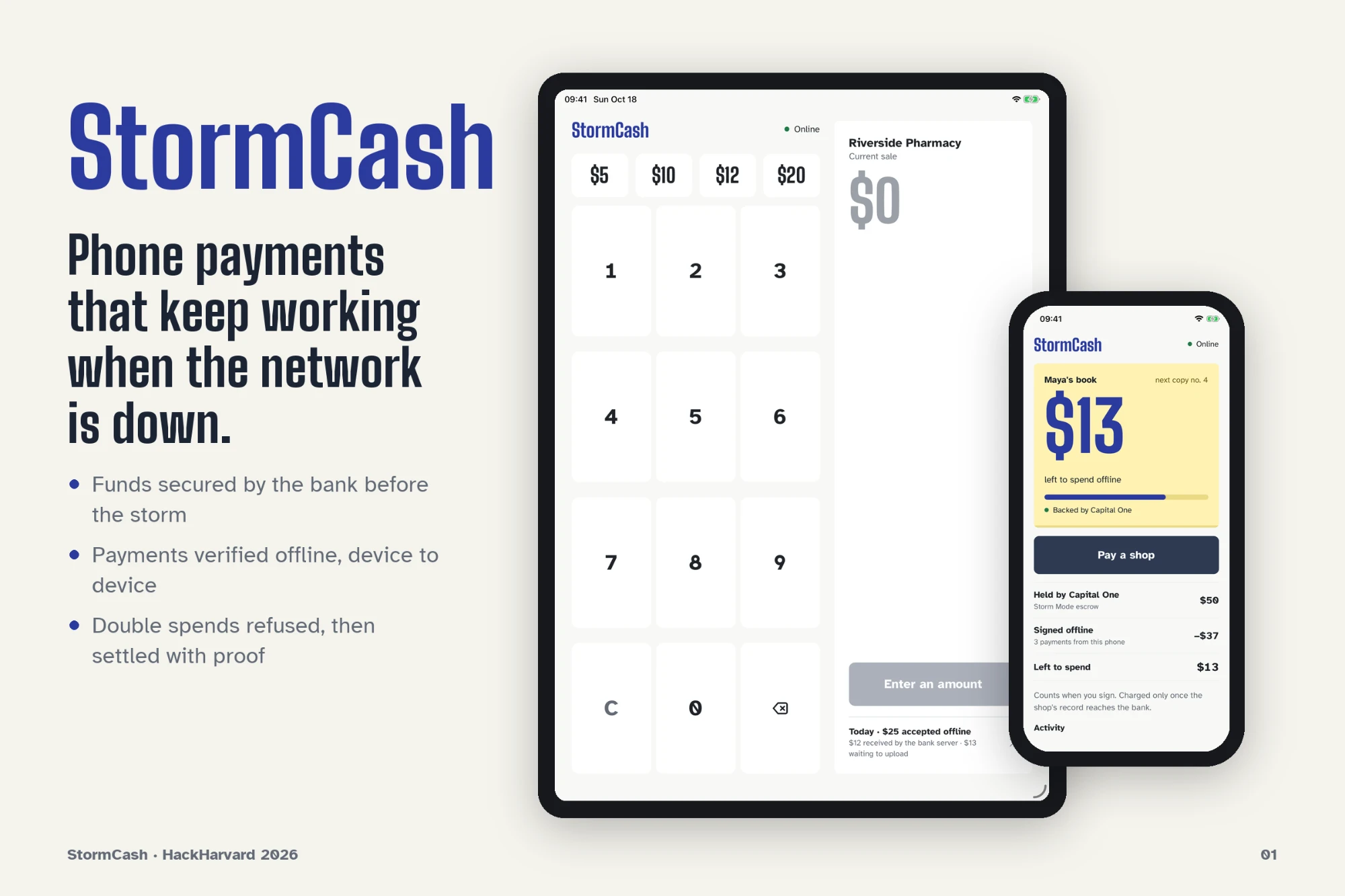
StormCash on an iPad checkout and an iPhone wallet: $13 left to spend offline, backed by Capital One.

HackHarvard 2026, Harvard University

StormCash

Two-person team, built in 2 days

Honorable mentionCapital OneHackHarvard 2026

Pay offline. Refuse double spends. Settle with proof.

When a disaster takes out cell towers and card readers, StormCash keeps phones paying local shops. The bank secures the money before the storm, shops verify each payment offline, phone to phone, and anyone who rolls back their wallet to spend twice is refused, then settled with proof. I owned everything behind the phones. Math flags, an agent investigates, a person decides.

GitHub for StormCash

shared test vectors matched in Python, TypeScript and C++ SC1
124
loading the simulated town into Postgres SC2
46 min → 40 s
residents in the C++ network simulator SC3
1M
held-out frauds surfaced, 0 of 11 false flags SC4
8 / 9
  • The payment protocol: signed, hash-chained spend tags (ECDSA P-256) frozen as 124 shared test vectors that the Python server and the TypeScript app reproduce byte for byte, plus a C++20 verifier that passes 262 Wycheproof tests and re-checks fraud proofs in the browser via WebAssembly.
  • The FastAPI/Postgres settlement server: store-and-forward uploads, a double-entry ledger reconciled with the Capital One Nessie API, and bank transfers replayed until both halves land. Pipelining writes cut loading the simulated town from 46 minutes to 40 seconds.
  • A multithreaded C++ Monte Carlo simulator of the phone-to-phone gossip network, validated against the Python engine on 10 metrics and run up to 1M residents (45 s per run).
  • A fraud-triage agent on the Factory Droid SDK with read-only MCP tools, a citation check and a reviewer agent that tries to refute each proposal. On held-out towns evaluated in Chalk, 8 of 9 frauds reached a person with 0 of 11 honest subjects flagged, versus 11 of 11 for a rules-only baseline.
Oct 2026Python · FastAPI · Postgres · C++20 · WebAssembly · React · Factory Droid SDK · Chalk · Capital One Nessie

DivHacks 2026, Columbia University

Ellipsis

Two-person team, built in 2 days

WinnerBest Use of DigitalOceanDivHacks @ Columbia University

Detect a blockage. Measure the impact. Test a response.

For the operators at NYC DOT’s traffic management center. When a vehicle blocks a lane on one of 9 live Midtown cameras, Ellipsis opens an incident with the camera frame as evidence. A SUMO simulation then compares the current signal timing against a retimed one, and the operator sees both before deciding. It flags, it checks, a person decides.

Live site for EllipsisPitch deck (PDF) for EllipsisGitHub for Ellipsis

precision / recall on 15 hand-tagged blockages L2
88% / 93%
median from a vehicle stopping to the alert L2
63 s
live NYC DOT cameras watched L1
9
signalized intersections in the SUMO model L3
88
  • The detection half of the pipeline: YOLO11, a custom IoU tracker and lane-mask dwell rules on 9 live NYC DOT cameras, flagging double parking, vehicles stopped in a lane and blocked intersections.
  • An evaluation harness against hand-tagged ground truth, with cached detections so a rule change is re-scored in seconds. Tuning thresholds with it reached 88% precision and 93% recall on 15 blockages, with a median of 63 s from a vehicle stopping to the alert.
  • The FastAPI backend and the dashboard’s congestion heatmap, handing each alert to the SUMO model of Midtown (88 signalized intersections) that scores a signal timing change for the operator to approve.
  • Recording and replay tooling that runs real, hand-checked incidents through the same pipeline, so the public site plays a recorded incident whenever the live backend is down.
Sep 2026Python · YOLO11 · FastAPI · SQLite · SUMO · React · MapLibre · Docker · DigitalOcean

AI study app for university classes

Benkyo

Upload a class’s notes, slides and past exams, and Benkyo reads them into chapters, writes study notes, answers questions with citations, quizzes you and plans the weeks to the exam. It started as a study timer synced between devices. Invite-only for now.

fujibenkyo.com for Benkyo

What happens to a sourceB1B2B4
  1. ReadEvery page, by Claude or Gemini
  2. FileKind of source, chapter per passage
  3. StudyNotes, questions, cards, exams
  4. PlanDays to each deadline
  • A reading pipeline in Cloud Functions: the AI reads every page of a PDF or photo into Markdown, decides what each source is (lecture, problem set, practice exam, solutions) and files its passages under chapters. Practice exams never feed the notes, so they stay useful as tests.
  • Chapter notes with worked examples, answers to questions cited back to the pages they come from and streamed as they’re written, and spaced-repetition cards (SM-2) that add drills on chapters the student keeps missing.
  • An exam room: the class’s real practice exams set up from the uploaded paper, or new ones written from the notes, graded by the AI, including handwritten answers handed in as photos.
  • A study plan that works back from each deadline, weighing chapters by what the exam covers, the student’s accuracy on each and the minutes the timer logged on it.
  • Each AI task (reading, questions, writing, grading) routed to Claude Opus, Sonnet or Haiku from an admin setting, with Gemini as backup. Every call is metered for cost, and plan limits are enforced server-side, refunded when a call fails.
  • Invite-only access through custom auth claims, Firestore and Storage security rules tested against the emulators, and link imports that refuse private and cloud-metadata addresses.
Apr 2026 – presentTypeScript · React · Firebase · Cloud Functions · Claude API · Gemini API

Open-source contribution

kornia

A differentiable computer vision library for PyTorch, 11k+ stars on GitHub. I’m working through its flake8-simplify lint cleanup, one rule at a time.

My pull requests for korniaTracker #2445 for kornia

rules
14 fixed and enforced
violations
170 resolved
pull requests
14 opened, 14 merged
tracker
kornia #2445
  • Fixed 170 violations of 14 Ruff lint rules across 14 merged PRs, adding each rule to the CI-enforced config.
  • Rewrote two always-true test assertions that could never fail into the tensor shape checks they were meant to be.
  • Removed 7 unreachable branches in the augmentation containers, after tracing their origin through git history.
Oct 2026 – presentPython · PyTorch · Ruff · pytest · Pixi

AI teaching assistant

Megatron

Answers student questions from the course’s own materials, and sends anything it isn’t sure about to the instructor.

GitHub for Megatron

What happens to a questionM2
  1. RetrievalCourse materials in ChromaDB
  2. ClassificationClaude API, tunable threshold
  3. Generate or escalateRAG answer, or instructor queue
  4. PersistenceEvery question logged

Below the confidence threshold, the default is a human.

  • RAG over the course’s own materials (ChromaDB, paragraph-aware chunks), so answers can’t make up course policy.
  • A Claude classifier answers each question or sends it to the instructor, based on a tunable confidence threshold that defaults to a human. Every question is logged.
  • Full-stack app in FastAPI + SQLAlchemy and React/Tailwind, with student, instructor and admin views.
Feb 2026 – Jun 2026FastAPI · SQLAlchemy · React · Tailwind · ChromaDB · Claude API

Older and smaller builds

  • Image classification & neural net fundamentalsMar 2026 – Jun 2026

    ResNet-34 fine-tuned to 89.6% on 50 bird species, plus backprop and a panorama stitcher from scratch.

    PyTorch · ResNet-34 · AdamW · NumPy

  • CineRate AISep 2025 – Oct 2025

    Scores movie reviews from TMDB, 89% accurate on 50,000 IMDB reviews.

    FastAPI · React · Scikit-learn · TMDB API

  • VR World2025

    A weather phenomenon turned into a room-scale Unity scene, with spatial rain and custom HLSL shaders.

    Unity · C# · ShaderLab / HLSL · Oculus XR SDK · Resonance Audio · SketchUp

  • Super Gun Bros2023

    Mario-style platformer where the power-up before the castle is an AK-47.

    Python · cmu_graphics · Pillow

Education

Boston University

B.A. Computer Science, Minor in Statistics

Dean’s List.

Coursework

  • Analysis of Algorithms
  • Geometric Algorithms
  • Computer Systems
  • Probability in Computing
  • Introduction to Databases
  • Combinatoric Structures
  • Distributed Systems
  • Concepts of Programming Languages
  • Multivariate Calculus

Yonsei University

Study abroad, Seoul, South Korea

Coursework

  • Computer Vision
  • Human-AI Interaction
  • Intensive Korean Language, Level 1

Carnegie Mellon University

Pre-College

Coursework

  • Fundamentals of Programming & Computer Science

Skills

Languages

Libraries & frameworks

  • PyTorch
  • torchvision
  • Scikit-learnE3
  • NumPyY2
  • Pandas
  • Hugging Face
  • YOLOL1
  • FastAPISC2L3M3
  • SQLAlchemyM3
  • React.jsM3
  • TailwindM3
  • Factory Droid SDKSC4

Tools & platforms

Concepts

  • LLM agentsQ1E2SC4
  • LLM evaluationQ2SC4
  • Distributed systemsSC3
  • CryptographySC1
  • Deep learning
  • Computer visionL1Y1
  • Machine learningE1
  • Data structures & algorithms
  • Data visualizationE1

Spoken languages

Grew up across France, Germany and Ukraine.

Contact

Email is the most reliable way to reach me.

Based in
Boston, Paris, Tokyo and Zurich.